Reimagining Learning, Work and the Future of Education in Pakistan
Artificial Intelligence is changing the world faster than many people expected. For some, AI represents opportunity, innovation and a better future. For others, it creates fear about jobs, education, creativity and the future role of human beings. This fear is understandable, but the future of AI should not be defined by a competition between humans and machines. The more important question is how humans can learn to work with AI. The emerging answer is the Human–AI Copilot Model, where artificial intelligence supports human intelligence without replacing human purpose, judgement and responsibility.
THE COPILOT IDEA
A copilot supports the pilot, but the pilot remains responsible for the journey. AI should be understood in the same way. It can provide information, analyze data, generate ideas, explain difficult concepts, assist with writing and programming, identify patterns and automate repetitive tasks. Yet humans must continue to provide purpose, values, context, creativity and final judgement. AI can suggest a direction, but humans decide where they want to go. AI can generate an answer, but humans must determine whether that answer is correct, useful and ethical.
This creates a powerful partnership: Human Intelligence + Artificial Intelligence = Augmented Intelligence. The goal is not to make humans less important but to increase what humans are capable of achieving. AI is extremely powerful at processing information and recognizing patterns, while human beings bring experience, empathy, imagination, cultural understanding and moral responsibility. When these capabilities work together, technology becomes a tool for human progress rather than a replacement for humanity.
FROM FEAR TO UNDERSTANDING
Every major technological revolution has created uncertainty. Machines changed factories, computers changed offices and the internet changed communication. AI is now changing the way people learn and work. The natural reaction is to ask, “Will AI replace me?” But a better question is, “How can I work with AI to become more capable?”
This change in mindset is essential. Fear focuses on what technology might take away. Learning focuses on what technology can make possible. People who understand AI will be better prepared to adapt as jobs and industries change. The future will not necessarily belong to people who know everything about AI; it will belong to people who know how to combine AI with their own knowledge and professional skills.
AI AND THE FUTURE OF EDUCATION
Education is perhaps the most important area in which this transformation can take place. An AI copilot can give students personalized explanations, provide examples, generate practice exercises, offer feedback and help them explore subjects beyond the limits of a traditional textbook. A student struggling with mathematics can ask AI for another explanation. A language learner can practice conversation. A programming student can receive help identifying an error in code. A researcher can use AI to organize information and explore research questions.
But there is an important difference between using AI to learn and using AI to avoid learning. If a student asks AI to write an assignment and submits it without understanding the content, AI has become a shortcut. If the student uses AI to ask questions, challenge ideas, receive feedback and improve their own work, AI has become a learning partner. The future of education should therefore teach students not simply how to use AI, but how to think with AI.
THE TEACHER AS HUMAN GUIDE
The rise of AI does not mean the end of the teacher. In many ways, it makes the human role of the teacher more important. AI can generate a lesson plan, but a teacher understands the individual needs of students. AI can explain a scientific concept, but a teacher can recognize when a student is confused or losing confidence. AI can provide information, but a teacher can teach values, discipline, curiosity and responsibility.
The teacher of the future will increasingly become a mentor, coach, research guide and learning designer. AI can reduce repetitive administrative work and help prepare educational material, allowing teachers to spend more time interacting with students. The future classroom should therefore not be AI instead of teachers, but teachers empowered by AI.
THE STUDENT AS A CREATOR
The student of the AI era must also develop a new mindset. Memorization will remain useful, but it will no longer be enough. Students will need to ask better questions, investigate problems, evaluate information, communicate ideas and create solutions. AI can produce ten possible answers, but the student must decide which answer is meaningful. AI can generate an essay, but the student must contribute original thinking. AI can write computer code, but the student should understand what that code does.
The learning cycle of the future can therefore be expressed as:
ASK → EXPLORE → VERIFY → CREATE → REFLECT
AI can participate in every stage, but the human learner remains at the centre.
PAKISTAN’S AI OPPORTUNITY
For Pakistan, AI can become more than a technological trend. It can become an opportunity to strengthen education, research, employment and entrepreneurship. Pakistan has a large young population and a growing community of students, educators, technology professionals and entrepreneurs. If these human resources are combined with AI skills, the country can create new opportunities across many sectors.
AI can support students in universities and schools, assist teachers with educational resources, help researchers analyze large volumes of information and enable entrepreneurs to develop new digital services. AI applications could support areas such as agriculture, education, healthcare research, financial technology, engineering, climate studies, business analytics and local-language technology. Pakistan should aim not only to become a consumer of AI but also a creator of AI solutions designed for Pakistani challenges.
HUMAN + AI: THE FUTURE MODEL
The Human–AI relationship can be understood through a simple principle: the human chooses the destination, AI helps navigate the possibilities, and the human remains responsible for the journey.
AI can analyze. Humans interpret.
AI can generate. Humans evaluate.
AI can automate. Humans decide.
AI can suggest. Humans take responsibility.
This is why AI should be called a copilot rather than a replacement. The purpose of a copilot is to make the pilot more capable, not to remove the pilot from the cockpit.
THE SKILLS THAT WILL MATTER
The future workforce will require both technical and human capabilities. AI literacy, data understanding, generative AI, automation, AI-assisted research and AI application development will become increasingly valuable. At the same time, critical thinking, creativity, communication, collaboration, leadership, adaptability and ethical judgement will remain essential.
In fact, human skills may become even more valuable as AI becomes more capable. When information is abundant, the ability to identify what matters becomes important. When AI can generate content, originality becomes important. When machines can automate tasks, judgement becomes important. When AI can produce answers, the ability to ask the right questions becomes one of the most valuable skills.
RESPONSIBLE AI: KEEPING HUMANS AT THE CENTRE
Moving from fear to future does not mean ignoring the risks of artificial intelligence. Pakistan must develop responsible AI practices that protect privacy, academic integrity, fairness and human agency. Students should learn that AI-generated information can contain errors. Teachers should understand how to evaluate AI-assisted work. Institutions should develop clear guidelines for responsible use. Most importantly, AI should remain a tool that serves human goals rather than becoming a system that determines those goals.
The future of education should therefore be human-centred and AI-enabled. Technology should expand opportunity, not increase inequality. AI should support teachers rather than undermine them. It should help students learn rather than encourage intellectual dependence. It should accelerate research while maintaining academic responsibility.
FROM FEAR TO FUTURE
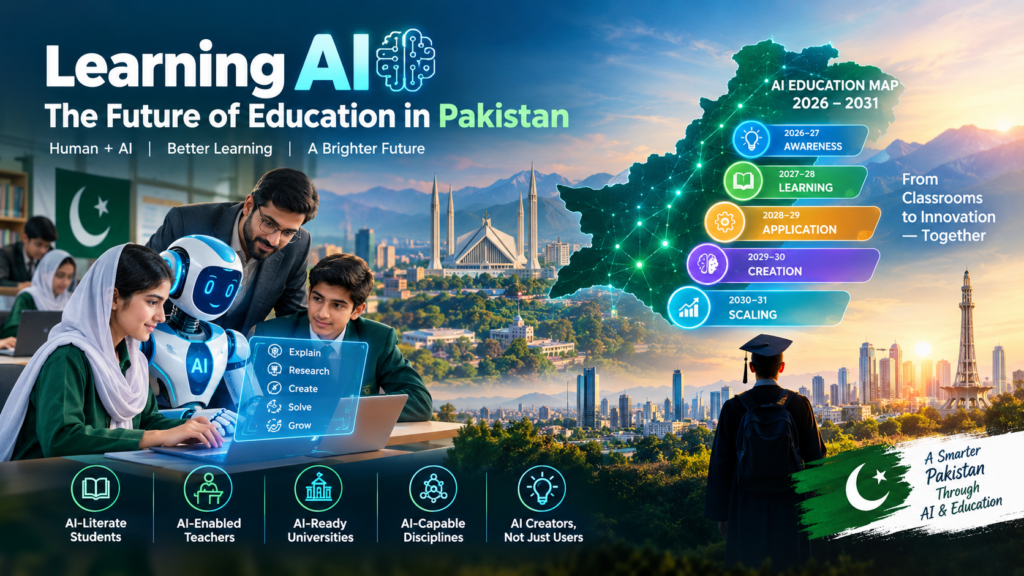
The transition from fear to future begins with learning. People cannot confidently work with a technology they do not understand. Pakistan’s first priority should therefore be to build AI literacy across schools, universities and professional environments. The next priority should be practical application and innovation, so that people learn not only how AI works but how it can be used to solve meaningful problems.
The journey from fear to future requires a change in mindset. Instead of asking only what AI might take away from us, we should ask what humans can accomplish with AI that was previously difficult or impossible. This does not mean ignoring the risks. Responsible AI adoption requires ethical standards, privacy protections, transparency and human accountability. But fear alone cannot prepare society for technological change. Learning can.
THE FINAL VISION
The future is not Human versus AI.
The future is:
HUMAN + AI
A future where every learner can use AI intelligently, every teacher can use AI effectively, every university can support AI-based research and innovation, and every professional can work alongside intelligent systems without losing human judgement.
Pakistan’s greatest AI resource is not simply computing power or software. It is its people. If Pakistan combines its young talent, teachers, universities, researchers, entrepreneurs and technology with responsible AI adoption, it can move from being a consumer of technology to becoming a creator of solutions.
The journey from fear to future does not require humanity to surrender to artificial intelligence. It requires humanity to understand it, question it, use it responsibly and lead it.
AI can be the copilot. Humanity must remain the pilot.